

By Alicia Moreno · Research Writer
Published
Answer in brief
Telematics and usage-based auto insurance programs monitor actual behind-the-wheel behavior—such as mileage, braking, and speed—rather than relying solely on your credit profile. For drivers penalized by a low credit-based insurance score, choosing a driving-tracking policy offers an immediate way to prove low risk and earn substantial rate discounts. Pairing telematics participation with deductible adjustments can overcome credit surcharges while keeping necessary legal protections intact.
How Usage-Based Tracking Separates Driving Risk From Credit History
In most states, insurance companies rely heavily on a credit-based insurance score to place applicants into a pricing tier. Regulatory findings, such as Arkansas insurance department data cited by the Insurance Information Institute, indicate that credit scoring lowers premiums on roughly 57% of policies but raises costs on roughly 23%. If past financial distress, medical debt, or thin credit history placed you in that higher-cost tier, traditional rating formulas assume you represent a higher likelihood of filing a claim, regardless of your actual safety record on the road.
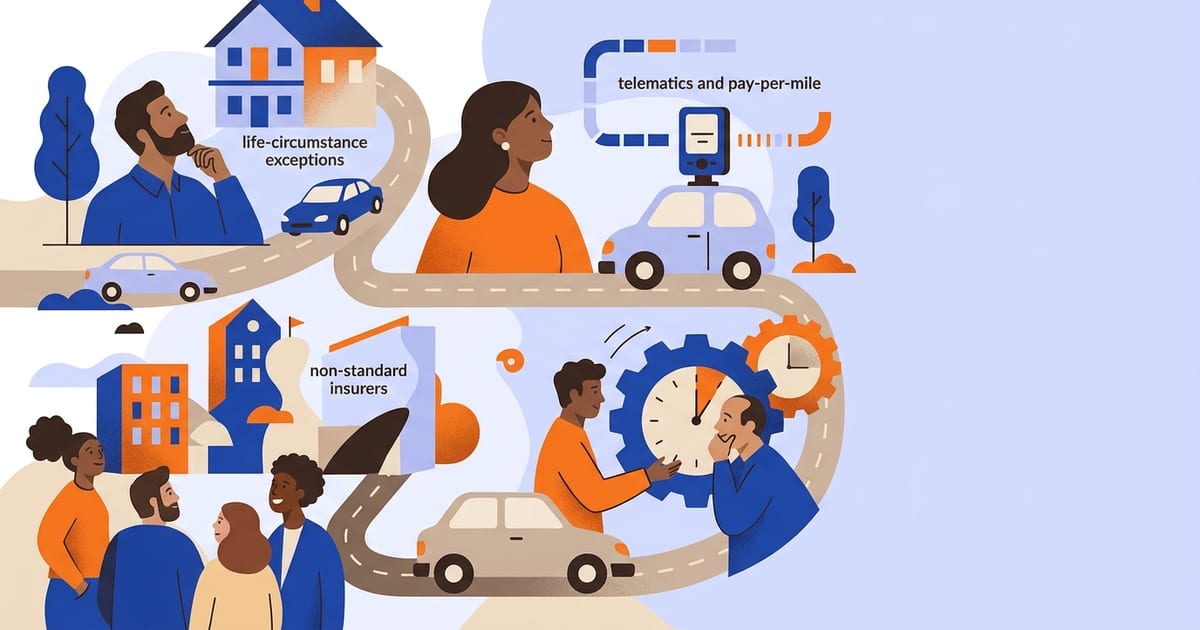
Telematics programs—frequently structured as usage-based insurance or pay-per-mile coverage—shift the underwriting focus back to behavioral risk. By gathering data through a mobile application or an onboard plug-in device, insurers track how, when, and how far you drive. For motorists with poor credit who maintain cautious driving habits, telematics provides an empirical counterweight against unfavourable financial scores.
What Telematics Devices Monitor and How Insurers Calculate Discounts
Under standard telematics frameworks documented by the Insurance Information Institute, tracking applications measure specific behavioral variables known to correlate with loss frequency. These include excessive speed, rapid acceleration, hard braking, late-night driving hours, total annual mileage, and handheld phone interaction while moving. Because higher speeds exponentially increase crash severity—as verified by research from the Insurance Institute for Highway Safety—avoiding hard stops and maintaining posted speeds generates favorable behavioral scores.
When you enroll, most carriers grant a small participation discount on your premium during an introductory evaluation window (typically 30 to 90 days). Once the tracking period concludes, the carrier calculates a driving safety score. If your score reflects low annual mileage and gentle vehicle control, the resulting performance discount offsets the penalty assigned by your credit tier. Furthermore, in states where insurance statutes restrict credit scoring from being the sole basis for rate increases or non-renewals, documented safe driving data provides strong leverage when requesting an underwriting re-rate.
Combining Telematics With Structural Policy Adjustments to Cut Costs
Telematics is most effective when paired with structural coverage changes that directly lower base premiums. The Insurance Information Institute notes that raising your comprehensive and collision deductible from $200 to $500 can cut physical damage coverage costs by 15% to 30%, while increasing the deductible to $1,000 can reduce those costs by 40% or more. If your vehicle is older and market value has depreciated significantly, dropping optional physical damage coverages altogether—while keeping robust liability protection—eliminates a major portion of the premium surcharge associated with poor credit.
Steps to Secure a Telematics Policy With Poor or Thin Credit
- 1
Gather Baseline Driving Information
Estimate your actual annual mileage and identify any driving habits that work in your favor, such as avoiding late-night commutes or working from home.
- 2
Request Quotes Specifying Usage-Based Programs
When shopping across at least three insurers, select telematics or pay-as-you-drive participation to unlock immediate onboarding discounts.
- 3
Check Rating Terms for Inactivity or Score Penalties
Review program rules before consenting to tracking. Confirm whether poor driving scores can raise base rates or simply result in zero discount at renewal.
- 4
Maintain Safe Driving Habits During the Monitored Period
Avoid abrupt stops, observe posted speed limits, eliminate mobile device handling while driving, and reduce unnecessary peak-hour travel.
- 5
Apply Earned Discounts and Request Policy Review
After the evaluation period, verify that your earned telematics tier discount is applied to your renewal premium schedule.
Questions & answers
Can a telematics program check my credit score anyway?
In states where credit scoring is legally permitted, insurers often run an initial credit check to establish a baseline tier. However, participating in a telematics program allows your actual driving performance to apply direct percentage discounts that reduce or eliminate the premium difference caused by low credit.
Can my car insurance rates increase if I drive poorly during telematics tracking?
It depends on the carrier and state regulations. Some telematics programs guarantee that rates will not increase above the standard baseline and only offer discounts. Other programs may surcharge drivers who exhibit frequent extreme braking, excessive speeding, or late-night driving. Always review program disclosures before enrolling.
What happens if I work from home and drive very low annual mileage?
Low-mileage drivers benefit significantly from telematics and pay-per-mile coverage. Because crash frequency decreases with fewer miles on the road, verified low mileage can reduce your premium substantially regardless of your credit score.
Does enrolling in a telematics program impact my credit score?
No. When an insurance company assesses your credit, it conducts a soft inquiry, which does not affect your credit score or credit report. Enrolling in or completing a telematics program has no connection to credit bureaus.
Terms: Credit-based insurance score, Telematics (usage-based insurance), Pay-per-mile insurance, Rating tier, Deductible
Sources and references
Legal figures on this page (minimum limits, filing periods, statutory benefits) are checked against the primary law or the state insurance regulator listed below. Links and figures last verified Nov 2026.
- Insurance Code § 1861.02 — rating factors and Good Driver Discount — California Legislative Information, Cal. Ins. Code § 1861.02Primary lawRates must be determined by, in decreasing order of importance, driving safety record, annual miles driven and years of driving experience; optional factors may follow. Good Driver Discount policies must be at least 20% below the rate otherwise charged.
- Credit-based insurance scores (insurance topic) — National Association of Insurance CommissionersState insurance regulatorIn most states insurers may not use a credit score as the sole reason to raise rates or decline, cancel or non-renew; many states require adverse-action notices.
- State chart: use of credit reports/scoring in underwriting — National Association of Insurance Commissioners (2025)State insurance regulatorState-by-state statutory summary; e.g. Massachusetts (auto rates may not be based on credit), Michigan (credit score prohibited, MCL 500.2162), Maryland (credit may rate a new auto policy only).
- Background on: Pay-as-you-drive auto insurance (telematics) — Insurance Information InstituteIndependent researchUsage-based and per-mile pricing models, what telematics programmes measure, and state limits on their use.
- Background on: Insurance scoring — Insurance Information InstituteIndependent researchWhat credit-based insurance scores are; Arkansas regulator data showing credit lowered premium on ~57% of auto policies and raised it on ~23%.
- Speed — Insurance Institute for Highway SafetyIndependent researchHow speed raises crash likelihood and severity; speed-limit and enforcement research.
- 2019–2023 Auto Insurance Database: average premium supplement — National Association of Insurance Commissioners (2025)Statistical dataCountrywide average expenditure $1,281 in 2023 (+13.98%); combined average premium $1,438; state tables for liability, collision and comprehensive.
- Nine ways to lower your auto insurance costs — Insurance Information InstituteConsumer guidanceShop at least three quotes; raising a deductible from $200 to $500 can cut collision/comprehensive cost 15–30%, $1,000 can save 40%+; drop physical damage on cars worth under 10× the premium; bundling, low-mileage and good-student discounts.
Practical guidance on this page is original editorial work. Cited sources support factual statements and do not endorse this site. Dollar ranges described as typical or illustrative are editorial estimates, not figures from these sources.