

By Alicia Moreno · Research Writer
Published · Updated
Answer in brief
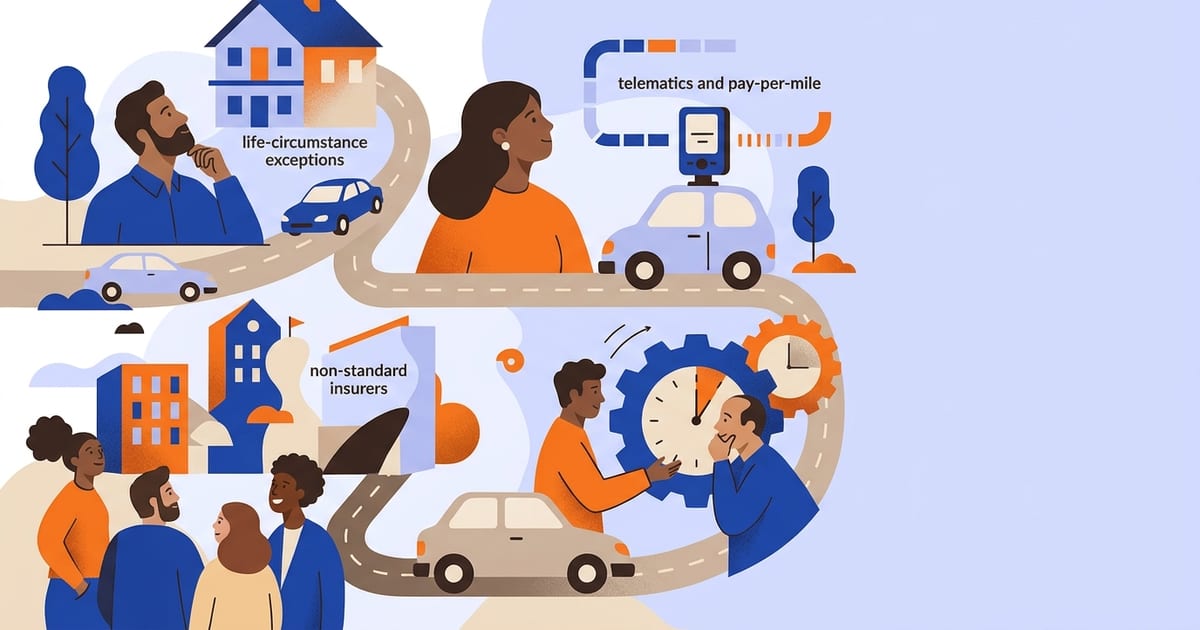
If credit is inflating your premium, you have more options than waiting for the score to improve. Request an extraordinary-life-circumstance exception if a qualifying event caused the credit damage. Enrol in telematics or pay-per-mile, which price on measured driving and reduce credit's weight. Include non-standard insurers in your comparison. Adjust coverage—higher deductibles, dropping collision on a low-value car—to cut the base the credit factor multiplies. And compare at every renewal, because insurers' credit models differ more than any other factor.
1. Life-circumstance exceptions
Most states require insurers to make reasonable exceptions to credit-based rating when the credit problem resulted from an extraordinary event: catastrophic illness or injury, death of a spouse or child, divorce, involuntary job loss, identity theft, military deployment, or a natural disaster. You must request it in writing and provide documentation. Insurers then rate you as if the event had not occurred, or exclude credit entirely.
2. Usage-based pricing
Telematics and pay-per-mile programmes shift weight from who you are to how you drive. For a careful or low-mileage driver with poor credit, this can be the largest available saving. Ask how the programme interacts with credit—some reduce its weight substantially after a measurement period.
3. Non-standard insurers
Specialists in higher-risk drivers often use credit lightly or not at all. Their base rates may be higher, so the net result depends on your profile. Include them in the comparison rather than assuming either way.
4. Shrink the base
Credit is a multiplier. A smaller premium before the factor means a smaller penalty after it: raise deductibles, review collision on an older car, correct mileage, and claim every discount.
Quote finder
Find auto insurance quotes that fit your situation
5. Compare, every renewal
Because credit models differ so much, the insurer that is cheapest for a poor-credit driver this year is often not cheapest next year as their score moves across tier boundaries. See how to compare.
Entries in this guide
Specific questions answered in more depth.
Questions & answers
What counts as an extraordinary life circumstance?
Typically serious illness, death of a close family member, divorce, involuntary job loss, identity theft, military deployment or natural disaster—varies by state.
Does telematics replace credit?
It reduces credit's weight at many insurers; a few price almost entirely on driving data after a measurement period.
Should I use a non-standard insurer if I have bad credit?
Include them in a comparison. They may or may not be cheaper depending on your other factors.
Terms used in this guide
- Extraordinary life circumstance exception
- A required exception to credit-based rating in many states when credit damage resulted from events such as serious illness, job loss, divorce, death of a family member, identity theft or disaster.
- Telematics (usage-based insurance)
- Pricing based partly on measured driving behaviour via an app or device. Shifts weight away from credit at many insurers.
- Pay-per-mile insurance
- A policy priced as a monthly base plus a per-mile charge. Some programmes use little or no credit information.
- Non-standard insurance
- The market segment for drivers with violations, lapses, no history or other factors standard insurers price steeply. Often uses credit lightly or not at all.
Sources and references
Legal figures on this page (minimum limits, filing periods, statutory benefits) are checked against the primary law or the state insurance regulator listed below. Links and figures last verified Nov 2026.
- Credit-based insurance scores (insurance topic) — National Association of Insurance CommissionersState insurance regulatorIn most states insurers may not use a credit score as the sole reason to raise rates or decline, cancel or non-renew; many states require adverse-action notices.
- State chart: use of credit reports/scoring in underwriting — National Association of Insurance Commissioners (2025)State insurance regulatorState-by-state statutory summary; e.g. Massachusetts (auto rates may not be based on credit), Michigan (credit score prohibited, MCL 500.2162), Maryland (credit may rate a new auto policy only).
- Background on: Insurance scoring — Insurance Information InstituteIndependent researchWhat credit-based insurance scores are; Arkansas regulator data showing credit lowered premium on ~57% of auto policies and raised it on ~23%.
- Background on: Pay-as-you-drive auto insurance (telematics) — Insurance Information InstituteIndependent researchUsage-based and per-mile pricing models, what telematics programmes measure, and state limits on their use.
- 2019–2023 Auto Insurance Database: average premium supplement — National Association of Insurance Commissioners (2025)Statistical dataCountrywide average expenditure $1,281 in 2023 (+13.98%); combined average premium $1,438; state tables for liability, collision and comprehensive.
- Nine ways to lower your auto insurance costs — Insurance Information InstituteConsumer guidanceShop at least three quotes; raising a deductible from $200 to $500 can cut collision/comprehensive cost 15–30%, $1,000 can save 40%+; drop physical damage on cars worth under 10× the premium; bundling, low-mileage and good-student discounts.
- Consumer insurance information — National Association of Insurance CommissionersConsumer guidancePlain-language guides from the body of state insurance regulators; links to every state's insurance department and complaint process.
- What determines the price of an auto insurance policy? — Insurance Information InstituteConsumer guidanceRating factors: driving record, mileage, location, age, gender, vehicle, credit-based insurance score, coverage choices. Notes ZIP-code rating is prohibited in California and Michigan and gender rating is prohibited in seven states.
Practical guidance on this page is original editorial work. Cited sources support factual statements and do not endorse this site. Dollar ranges described as typical or illustrative are editorial estimates, not figures from these sources.
Guide
How to Find Auto Insurers That Don't Check Credit
Where to find auto insurers that do not use credit or weight it lightly—non-standard specialists, telematics-first programmes, pay-per-mile insurers—and how to ask.
Guide
How to Improve Your Insurance Score
The specific actions that raise a credit-based insurance score—utilisation, on-time payments, disputing errors—and how to get your insurer to re-rate.
Guide
How to Compare Auto Insurance With Poor or No Credit
A comparison method tuned for credit-sensitive drivers: identical coverage, five quotes including non-standard and usage-based, direct credit questions, and timing around score changes.