

By Derek Nguyen · Editor
Published · Updated
Answer in brief
In most states, insurers use a credit-based insurance score as a rating factor. It is built from your credit report—payment history, debt levels, length of history, new accounts—but weighted to predict insurance losses rather than loan default, and it is pulled with a soft inquiry that does not affect your credit. The effect is large: drivers in the lowest tier commonly pay 50–100% more than those in the highest. Insurers justify it with correlation data; four states have banned it and others restrict it.
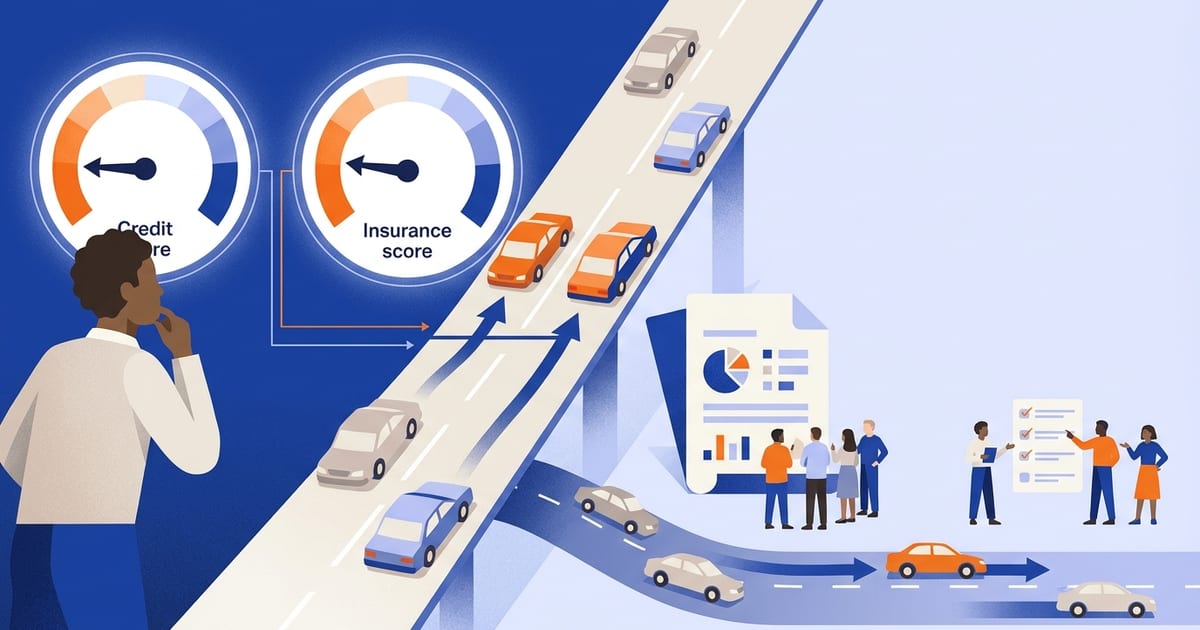
Insurance score vs credit score
| Credit score (lending) | Credit-based insurance score | |
|---|---|---|
| Predicts | Loan default | Likelihood and cost of insurance claims |
| Built from | Credit report | Credit report (different weights) |
| Uses income, employment, address? | No | No |
| Inquiry type | Hard (when applying for credit) | Soft—no effect on your credit |
| Can you see it? | Yes, widely | Rarely; insurers must explain adverse actions |
What moves the score
- Payment history — late payments, collections, bankruptcies weigh most.
- Outstanding debt and utilisation — high balances relative to limits lower it.
- Length of credit history — longer is better.
- New credit — several recent applications lower it.
- Credit mix — minor factor.
Why insurers use it
Actuarial studies have repeatedly found a correlation between insurance scores and claim frequency. Insurers treat the score as a predictor like age or record. Consumer advocates argue that it penalises financial hardship rather than driving behaviour and falls hardest on lower-income households. Both positions are reflected in state law: most states allow it with limits; a few prohibit it.
Quote finder
Find auto insurance quotes that fit your situation
What "no credit check" really means
Almost every insurer in a state that permits credit rating will pull an insurance score. "No credit check auto insurance" in practice means one of three things: insuring in a state that bans credit rating; finding one of the minority of insurers that do not use it; or, most realistically, finding insurers that weight it lightly. The finding insurers guide explains how.
Entries in this guide
Specific questions answered in more depth.
Entry
What an Insurance Adverse Action Notice Means
If credit raised your auto insurance rate, you receive an adverse action notice. What it says, what rights it gives you and what to do with it.
Entry
Can an Auto Insurer Cancel Your Policy if Your Credit Score Drops?
Learn whether an auto insurer can cancel or non-renew your policy over a drop in credit, what state laws require, and your rights under adverse action rules.
Questions & answers
Does getting an auto insurance quote hurt my credit?
No. Insurers use soft inquiries, which are invisible to lenders and do not affect your score.
Is my insurance score the same as my FICO score?
No. It uses the same report but different weights, and predicts claims rather than default.
Can I see my insurance score?
Rarely directly. If credit raises your rate, the insurer must send an adverse action notice listing the main reasons.
Terms used in this guide
- Credit-based insurance score
- A score derived from your credit report and weighted to predict insurance losses. Used as a rating factor in most states; banned in California, Hawaii and Massachusetts, with Michigan barring use of the credit score itself.
- Soft inquiry
- A credit-report pull that does not affect your credit score and is not visible to lenders. Insurance quotes use soft inquiries.
- Rating factor
- Any characteristic used to set a premium: record, age, territory, vehicle, mileage, coverage and—where allowed—credit.
- Adverse action notice
- A required notice when credit information leads to a higher rate, lower tier or denial. Names the bureau, lists reasons and grants a free report.
Sources and references
Legal figures on this page (minimum limits, filing periods, statutory benefits) are checked against the primary law or the state insurance regulator listed below. Links and figures last verified Nov 2026.
- MCL 500.2111 — permitted and prohibited rating factors — Michigan Legislature, MCL 500.2111(4)Primary lawInsurers may not set auto rates on sex, marital status, home ownership, educational level, occupation, postal zone or credit score (as defined in § 2162).
- Insurance Code § 1861.02 — rating factors and Good Driver Discount — California Legislative Information, Cal. Ins. Code § 1861.02Primary lawRates must be determined by, in decreasing order of importance, driving safety record, annual miles driven and years of driving experience; optional factors may follow. Good Driver Discount policies must be at least 20% below the rate otherwise charged.
- Credit-based insurance scores (insurance topic) — National Association of Insurance CommissionersState insurance regulatorIn most states insurers may not use a credit score as the sole reason to raise rates or decline, cancel or non-renew; many states require adverse-action notices.
- State chart: use of credit reports/scoring in underwriting — National Association of Insurance Commissioners (2025)State insurance regulatorState-by-state statutory summary; e.g. Massachusetts (auto rates may not be based on credit), Michigan (credit score prohibited, MCL 500.2162), Maryland (credit may rate a new auto policy only).
- Background on: Insurance scoring — Insurance Information InstituteIndependent researchWhat credit-based insurance scores are; Arkansas regulator data showing credit lowered premium on ~57% of auto policies and raised it on ~23%.
- Insurance research and advocacy — Consumer Federation of AmericaConsumer guidanceConsumer-side research on auto insurance pricing, non-driving rating factors and affordability.
- Consumer insurance information — National Association of Insurance CommissionersConsumer guidancePlain-language guides from the body of state insurance regulators; links to every state's insurance department and complaint process.
Practical guidance on this page is original editorial work. Cited sources support factual statements and do not endorse this site. Dollar ranges described as typical or illustrative are editorial estimates, not figures from these sources.
Guide
States That Ban Credit in Auto Insurance
The states where insurers cannot use credit to rate auto insurance—California, Hawaii, Massachusetts—plus Michigan's credit-score ban and the states that restrict it.
Guide
How Much More Auto Insurance Costs With Bad Credit
Typical premium differences between credit tiers, how the effect compares with tickets and accidents, and how it varies by state and insurer.
Guide
How to Improve Your Insurance Score
The specific actions that raise a credit-based insurance score—utilisation, on-time payments, disputing errors—and how to get your insurer to re-rate.