

By Derek Nguyen · Editor
Published
Answer in brief
In most states, an insurer cannot cancel or refuse to renew your existing auto insurance policy solely because your credit score dropped. State regulations and the National Association of Insurance Commissioners strictly limit how credit can be used after underwriting, often requiring notice or restricting mid-term cancellations.
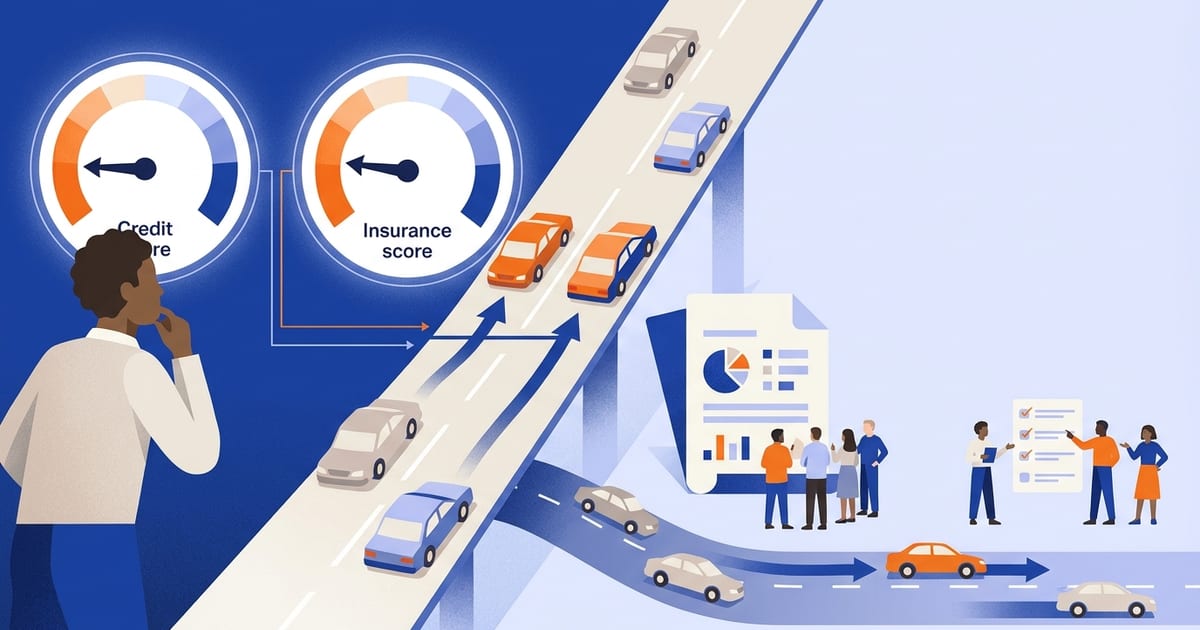
When unexpected expenses, layoffs, or medical bills cause your credit score to tumble, worrying about whether your auto coverage will suddenly vanish is natural. A lower score can create anxiety around your daily commute and financial stability. However, state insurance regulations provide clear safeguards that prevent auto insurers from terminating active policies solely because of personal credit changes.
Mid-Term Policy Cancellation vs. Non-Renewal
To understand how insurers handle a drop in your credit-based insurance score, it is essential to distinguish between mid-term policy cancellation and policy non-renewal at the end of your term.
- Mid-term cancellation: Insurers are strictly limited by state statutes regarding why they may cancel a policy mid-term. Allowable grounds are generally limited to non-payment of premium, substantial fraud or misrepresentation on your application, or the suspension of your driver's license. A drop in your credit-based score during an active policy period is not valid legal grounds for mid-term cancellation in any state.
- Non-renewal: Non-renewal occurs when an insurer decides not to offer another policy term after your current 6-month or 12-month policy expires. While underwriting rules at renewal are broader than mid-term rules, state guidelines still heavily restrict the use of credit.
How State Regulations Protect Drivers When Credit Declines
Insurance scoring rules vary across state lines. Regulators oversee how and when carriers calculate a credit-based insurance score to protect consumers from arbitrary penalties.
| Jurisdiction Pattern | Regulatory Rule on Auto Insurance Credit Scoring | Statutory or Model Protection |
|---|---|---|
| Banned states | Insurers cannot use credit scores at all to determine rates, cancellations, or renewals. | Prohibited entirely in Michigan (MCL 500.2111) and Massachusetts. |
| Restricted states | Credit may only be used when initially rating a new policy, not at renewal. | Maryland limits credit scoring strictly to new policies. |
| NAIC model states | Insurers cannot cancel, non-renew, or raise rates solely based on credit scores. | Enacted across the majority of standard US regulatory jurisdictions. |
Even where credit is a permitted rating factor, carriers rely on multifaceted actuarial algorithms. While a severe credit decline might prompt an insurer to shift your policy into a different rating tier at your renewal period, they cannot drop your coverage entirely based purely on that calculation.
What Triggers an Adverse Action Notice?
Under regulatory standards tracked by the NAIC, when an insurer uses your credit report to make an unfavorable decision—such as placing you in a higher rate tier or declining a tier discount at renewal—they must send you an adverse action notice.
Receiving an adverse action notice does not mean your policy has been canceled. Instead, it indicates that your credit data contributed to a higher pricing bracket than a driver with top-tier credit would receive. The notice outlines the specific factors that influenced your score, such as high debt balances or late payments.
What to Do if Your Rate Rises After a Credit Drop
If a declining score has pushed your renewal premium up, follow these concrete steps to keep your costs manageable while preserving your coverage:
- 1
Review Your Renewal and Adverse Action Notices
Verify the effective renewal date and read the four or five key factors listed on your adverse action notice so you understand what impacted your insurance score.
- 2
Request a Policy Re-Rate
If you have corrected reporting errors or paid down revolving balances, ask your carrier for a policy re-rate using updated consumer reporting data.
- 3
Adjust Physical Damage Deductibles
Raising your collision and comprehensive deductible from $200 to $500 can cut your physical damage costs by 15% to 30%, while a $1,000 deductible can save 40% or more.
- 4
Compare Quotes Across Alternate Carriers
Different insurance companies weight credit history differently; some proprietary models penalize score drops far less than others.
Shopping for Better Alternatives
When one insurer applies a punitive tier adjustment, another may offer significantly lower premiums for the identical driving profile. Shopping at least three independent quotes remains one of the most effective ways to lower your expenses without sacrificing essential liability protection.
Questions & answers
Can my car insurance be canceled immediately if my credit score drops?
No. State insurance regulations strictly prohibit mid-term cancellations based on credit. Insurers can generally only cancel an active policy for non-payment, fraud, or driver's license suspension.
Will my car insurance rate automatically increase at my next renewal?
Not necessarily. While some carriers review credit at renewal, others only check credit when issuing a new policy. Furthermore, in states like Michigan, Massachusetts, and California, credit scores cannot be used to adjust your rates at all.
What does an adverse action notice from an auto insurer mean?
An adverse action notice informs you that information in your credit report prevented you from receiving the lowest available rate tier. It does not mean your policy was canceled.
Can an insurer refuse to renew my policy solely because of credit?
In most states, insurance statutes follow NAIC model regulations prohibiting insurers from refusing to renew coverage solely because of a consumer's credit score.
Terms: Credit-based insurance score, Adverse action notice, Rating factor, Rating tier, Re-rate
Sources and references
Legal figures on this page (minimum limits, filing periods, statutory benefits) are checked against the primary law or the state insurance regulator listed below. Links and figures last verified Nov 2026.
- MCL 500.2111 — permitted and prohibited rating factors — Michigan Legislature, MCL 500.2111(4)Primary lawInsurers may not set auto rates on sex, marital status, home ownership, educational level, occupation, postal zone or credit score (as defined in § 2162).
- Credit-based insurance scores (insurance topic) — National Association of Insurance CommissionersState insurance regulatorIn most states insurers may not use a credit score as the sole reason to raise rates or decline, cancel or non-renew; many states require adverse-action notices.
- State chart: use of credit reports/scoring in underwriting — National Association of Insurance Commissioners (2025)State insurance regulatorState-by-state statutory summary; e.g. Massachusetts (auto rates may not be based on credit), Michigan (credit score prohibited, MCL 500.2162), Maryland (credit may rate a new auto policy only).
- Background on: Insurance scoring — Insurance Information InstituteIndependent researchWhat credit-based insurance scores are; Arkansas regulator data showing credit lowered premium on ~57% of auto policies and raised it on ~23%.
- What determines the price of an auto insurance policy? — Insurance Information InstituteConsumer guidanceRating factors: driving record, mileage, location, age, gender, vehicle, credit-based insurance score, coverage choices. Notes ZIP-code rating is prohibited in California and Michigan and gender rating is prohibited in seven states.
- Nine ways to lower your auto insurance costs — Insurance Information InstituteConsumer guidanceShop at least three quotes; raising a deductible from $200 to $500 can cut collision/comprehensive cost 15–30%, $1,000 can save 40%+; drop physical damage on cars worth under 10× the premium; bundling, low-mileage and good-student discounts.
- What if I can't find auto coverage? — Insurance Information InstituteConsumer guidanceHow the non-standard market and state assigned-risk plans insure drivers the voluntary market declines.
- Is it legal to drive without insurance? — Insurance Information InstituteConsumer guidanceEvery state requires drivers to demonstrate financial responsibility; in most states insurance is the mandatory way to do so.
Practical guidance on this page is original editorial work. Cited sources support factual statements and do not endorse this site. Dollar ranges described as typical or illustrative are editorial estimates, not figures from these sources.
Entry
What an Insurance Adverse Action Notice Means
If credit raised your auto insurance rate, you receive an adverse action notice. What it says, what rights it gives you and what to do with it.
Parent guide
How Credit Affects Auto Insurance Rates
What a credit-based insurance score is, how it differs from a credit score, how much it moves premiums, and why insurers are allowed to use it.